


You can say I am captivated and transfixed all over and once again. I know it always happens to me this way, as I have shared with you often in the past years and in my other blog posts. It was just recently that I had fallen in love, head over heels, with the poetry of Charles Bukowski, Pablo Neruda, and Fredric Garcia Lorca. Prior to that, I was swept away with the paintings of Francisco Clemente, Llyn Foulkes. Such has been going on as far as I remember. Now, these days, I am overwhelmingly taken and completely fascinated by artificial intelligence. I follow the direction it is taking on a daily basis, and at times, it feels quite strange living in a world that is telling us that seeing is not believing anymore. It is conceptually profound to think that one day, AI communication might even bypass language. While we are busy controlling our devices with our minds, human presence will gradually start to be rare and replaced by AI. It is hard to believe that one day we would be living amongst a constant battle for importance of efficiency against meaning and intelligence verses wisdom, and we would start to suffer from intellectual laziness.
I ask myself if AI can ever create purpose, or will that always remain human’s responsibility? I guess it remains to be seen.
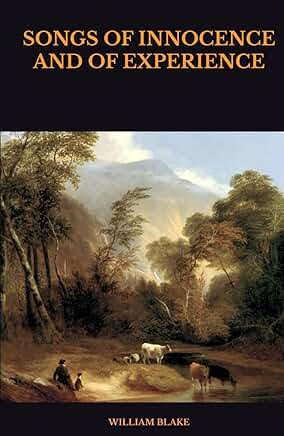
Lost in my thoughts, just out of nowhere, this thought comes into my mind: if I had a choice, and if I had the power, would I want to live in the future or in the past? I mean a far away past, like centuries ago, like going back to the late seventeeth century — going back to the age of tranquility and innocence. Or would I prefer to go forward in time and live in the robotic age of AI? As these thoughts pass my mind, I get up, walk towards my library and pick up this book to read: Songs of Innocence and of Experience by William Blake, the late seventeeth- to early eighteenth-century poet. I imagine myself living in that era, sitting under a tree in a green prairie on a mid-afternoon and reading William Blake’s poems line-by-line.
All the words and all the hidden references and meaning in this book feel really old, like an old painting which has been painted using only dark brown monotone colors and hues of damp wood and rusted iron. However, his biography claims the opposite. It says that his writings were quite rebellious and revolutionary, breaking all the rules. He stood apart from all the other poets of his time, and he believed imagination was not just fantasy but the highest form of perception, and that art should not look for agreement and approval, but at times, it should have the power to make you feel uncomfortable. He firmly believed that reality is always layered.
I agree with him. I say art is indeed a means of being able to peel away all these layers, to look at what is underneath. The question is, was he actually rebellious? I say, not at all. I think it is that as a deep thinker, he probably knew that all of us as human beings, living on this earth, try to justify our existence in whatever ways and means we are able to. However, all the while, we are still aware of this inevitable fact that we all disappear one day. Like fallen leaves, we will be swept with the breeze and will be taken away.
I think William Blake, especially as an artist and a poet, wanted desperately to write his name on the wall of life, just to say that he was here. Maybe after all, art and literature are, in fact, acts of rebellion against everything being so impermanent. Deep inside, we all know that life is about embracing all that is accessible and wonderful. However, at some point and time, with dignity and courage, it is about also being able to open our arms and letting it all go — the whole totality of it — all the goodness of life itself, which has been so generously offered to us and now alas has already been expired.
If we could only leave like a satisfied guest invited to this spectacular feast, who will graciously leave with no desire to stay passed his welcome.
I have been sitting here in my room, thinking and reading William Blake’s poems for a while now. It all makes me feel so nostalgic and melancholy. It feels similar to sitting on a wooden bench on an idle hour of the day in an old, silent, and cold museum, just staring aimlessly at a stunning renaissance oil painting of a dramatic landscape painted in all gloomy brown, gray, and dark green colors. I am still thinking and undecided: honestly, if I had a choice, would I want to live in the romantic era of the sventeeth century or in the time of a robotic AI-infused future?
The Sick Rose
O Rose thou art sick.
The invisible worm,
That flies in the night
In the howling storm:
Has found out thy bed
Of crimson joy:
And his dark secret love
Does thy life destroy.
The Tyger
Tyger Tyger, burning bright,
In the forests of the night;
What immortal hand or eye,
Could frame thy fearful symmetry?
In what distant deeps or skies.
Burnt the fire of thine eyes?
On what wings dare he aspire?
What the hand, dare seize the fire?
And what shoulder, & what art,
Could twist the sinews of thy heart?
And when thy heart began to beat.
What dread hand? & what dread feet?
What the hammer? what the chain,
In what furnace was thy brain?
What the anvil? what dread grasp.
Dare its deadly terrors clasp?
When the stars threw down their spears
And water’d heaven with their tears:
Did he smile his work to see?
Did he who made the Lamb make thee?
Ah! Sun-flower (1794)
Ah, Sun-flower! weary of time,
Who countest the steps of the Sun,
Seeking after that sweet golden clime
Where the travellers journey is done:
Where the Youth pined away with desire,
And the pale Virgin shrouded in snow,
Arise from their graves and aspire
Where my Sun-flower wishes to go.
London
I wander thro’ each charter’d street,
Near where the charter’d Thames does flow,
And mark in every face I meet
Marks of weakness, marks of woe.
In every cry of every Man,
In every Infants cry of fear,
In every voice: in every ban,
The mind-forg’d manacles I hear.
How the Chimney-sweepers cry
Every blackning Church appalls,
And the hapless Soldiers sigh
Runs in blood down Palace walls
Share this:

Tags: Book Reviews, Books & Poetry, Poetry, William Blake
Posted in Book Reviews, Reviews |
Leave a Reply